From Vesica Press
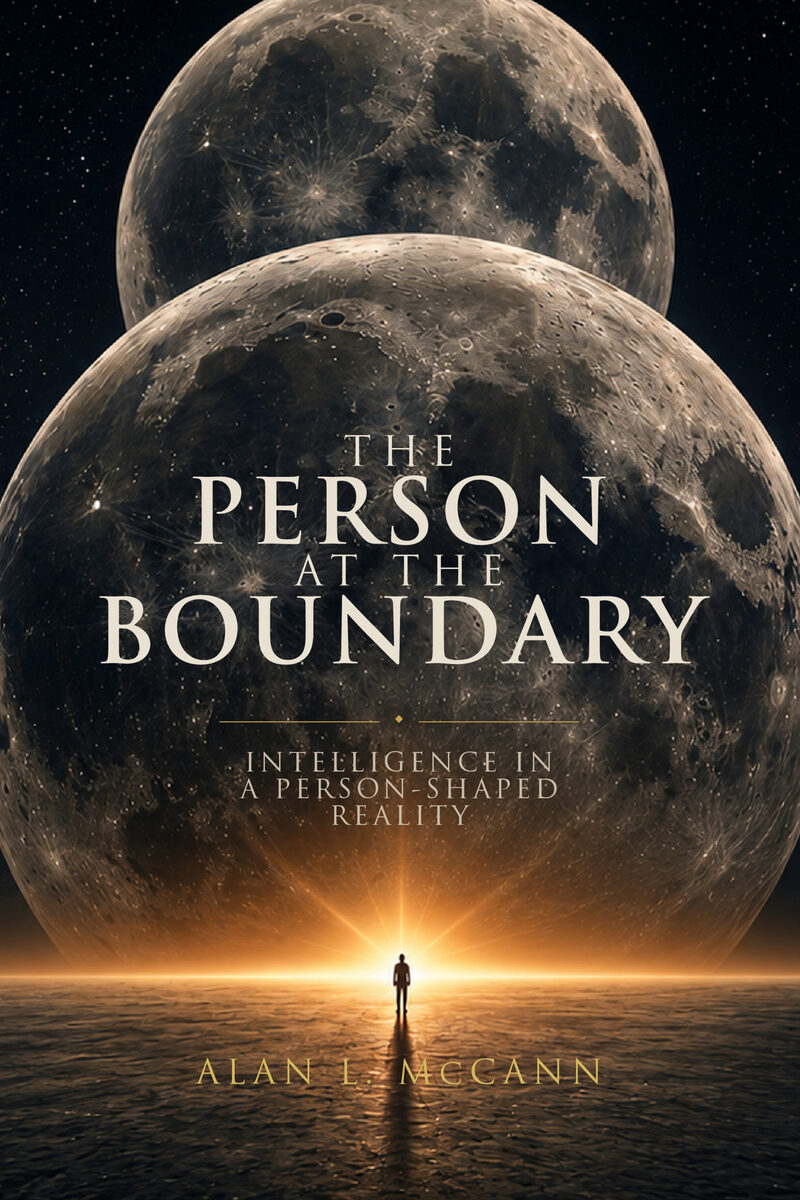
The Person at the Boundary
Intelligence in a Person-Shaped Reality
The machines are getting smarter. And something unexpected is happening: the better they get, the more clearly they reveal what they are not.
AI writes, diagnoses, translates, consoles. It does nearly everything — as if it understood, as if it cared, as if it judged. And “as if” turns out to be a boundary that no advance has ever moved. The closer the simulation comes, the sharper the line.
In The Person at the Boundary, Alan McCann traces that line from three independent directions: the mathematics of formal systems, which prove (in machine-checked theorems anyone can verify) exactly where computation stops; the Catholic understanding of the human person, which names what stands on the other side; and a working AI architecture he built, which discloses the boundary in running code. Three paths. One conclusion: reality is not machine-shaped, with persons as accidental passengers. Reality is person-shaped — and the most powerful formal systems ever built are the instruments revealing it.
Written in the wake of Magnifica Humanitas, Pope Leo XIV’s landmark encyclical calling the world to disarm AI, this is both a report on a discovery and a guide to living with it: what to delegate and what to take back, how to raise children and build communities at the boundary, and why the question was never what can I do that the machine cannot? — but what am I that the machine is not?
You are more real than you think. This book shows you why — and what to do about it.
"No computational system, however sophisticated, can create a heart that gives itself, or a conscience that discerns good from evil."
Pope Leo XIV, Magnifica Humanitas (2026)
Inside this book
- Why "alignment" cannot make machines moral, and what architecture can honestly do instead
- The true stories of the boundary: the surgeon and the scan, the nurse and the algorithm, the teacher who returned her classroom to paper
- A reader's guide to Magnifica Humanitas, keyed chapter by chapter to the book's argument
- Ancient practices (attention, silence, presence) re-presented as the formation the AI age demands
- A plain-language summary of the formal results, and instructions to verify every theorem yourself
For the believer who senses the machines are missing something but can't say what. For the skeptic willing to follow mathematics wherever it leads. For every parent, professional, and pastor deciding what to hand the machine and what to keep.
- Ebook
- $9.99
- Publisher
- Vesica Press